
The winner is...


Antoinette Galindo!
Thanks to everyone who entered the contest!

 YOU COULD WIN a prize pack courtesy of Focus Features and animation company LAIKA's ParaNorman!
 |
| click to enlarge |
 |
| click to enlarge |
 Shot in real time, The Sadist’s plot is unassumingly simple: Three schoolteachers on their way to a Dodgers ballgame – Carl (Don Russell), Ed (Richard Alden), and Doris (Helen Hovey) – have car trouble and pull into an isolated auto yard. There, they run into crazed killer Charlie (Arch Hall, Jr.) and his young, nubile girlfriend Judy (Marilyn Manning).
 Working from his own script, director James Landis does a superb job of creating tension. Even early in the film, as the teachers arrive at the auto yard, Landis sets the foreboding tone: When Ed yells for assistance and all he hears is his echo, it’s clear any later cries for help will fall on deaf ears.
 Just as Charlie shows no mercy for his hostages, Landis gives no relief to the audience. The Sadist is shockingly brutal and graphic for its time: Charlie verbally and physically tortures the teachers, and several scenes are indeed sadistic. The best example is the infamous “soda scene,” where Charlie tells one of his victims he’s going to shoot them in the head once he’s done his bottle of soda – all while the victim is on their knees, begging for their life. (An additional form of torture: Carl, Ed, and Doris can hear the ballgame they’re missing as it plays on the car radio.)
 Hall’s performance as Charlie falls between nutjob killer and goofy caricature, and this combination is what makes him so frightening. With a twisted grimace and a maniacal giggle (which Hall admits he stole from Richard Widmark’s hitman in Kiss of Death), Charlie also shows on several occasions that he may be crazy, but he’s not stupid. He’s often one step ahead of his captors, whether it’s counting the number of bullets he’s used or showing he knows more about cars than Ed thinks he does.
 One of the first films loosely based on 1950s serial killer Charles Starkweather (followed by the better-known Badlands and Natural Born Killers), The Sadist still packs a wallop nearly 50 years later. With a cast of five, one location, and a premise that (sadly) still resonates today, it’s a gem worth seeing.


 franchise – one whose likability and popularity was apparently evident by its billions in box office and the millions of moviegoers who have kept the saga afloat since the original Ice Age in 2002.
 Romano), sabre-tooth tiger Diego (Denis Leary), and Sid the sloth (John Leguizamo) as their herd (including Manny’s wife Ellie (Queen Latifah) and their teenage daughter Peaches (Keke Palmer)) get caught up in the cataclysmic separation of their landmass, casting Manny, Diego, Sid, and Sid’s eccentric Granny (Wanda Sykes) out to sea on a mass of ice.
 As our trio of heroes (plus 1) try to reach the destination where Ellie, Peaches, and the rest of the herd will meet them, they encounter simian sea pirate Captain Gutt (Peter Dinklage) and his crew, including first mate Shira (Jennifer Lopez), a sabre-tooth tiger who ends up with conflicting feelings about her captain and Diego.
 With all the effort the filmmakers behind Ice Age: Continental Drift put into the action scenes and stunning visuals (especially the breathtaking sequences of the giant land mass breaking apart), they should have devoted more to character development. Ironically, that devotion would be a major undertaking, for by continuously adding new characters with each film in the franchise, it leaves directors Steve Martino and Mike Thurmeier with the unenviable task of finding a purpose for each character in what is now a cast of dozens.
 This overpopulation is also a far cry from what made the original Ice Age’s core trio of Manny, Diego, and Sid fun to watch. Martino, Thurmeier, and Continental Drift’s trio of writers seem to agree, for the main plot sends Manny, Diego, and Sid (and Sid’s Granny) on their own adventure, relegating the rest of the cast to a B-story of trekking across the remaining landmass to reunite with our heroes.
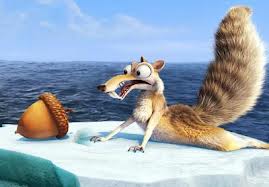
 The dialogue and jokes in Ice Age: Continental Drift rarely rise above the level of sitcoms or Saturday morning cartoons, and laugh-out-loud moments are at a minimum. The only exceptions are the adorable, hyperactive hyraxes (who form an Ewok-like alliance with Manny, Diego, and Sid to help bring down Captain Gutt) and the ongoing hilarious antics of Scrat the squirrel and his never-ending pursuit of his elusive acorn. Outside of that, the script largely serves to advance the plot to the finish line, peppered with mawkish Valuable Lessons and Very Special Moments about love, family, father/daughter relationships, and not forgetting your true friends.




 What’s even more frustrating is how the kids react upon meeting Labou. Most kids would probably say something like, “Omigod, it’s some kind of alien lizard creature! I hope it doesn’t have a taste for human flesh!” Instead, they’re merely curious about their not-of-this-earth discovery, and after five minutes they’re having an impromptu musical jam with him(!).
 Even worse than his unconvincing appearance, Labou disappears from the film for stretches at a time – forcing viewers to sit through either a) the three kid actors trying to carry their scenes; or b) unfunny slapstick and insults between a pair of bumbling father-and-son developers (Earl Scioneaux and Chris Violette) who want to raze Labou’s swampland home and build an oil refinery.
 While it’s too little too late, the last 20 minutes of Labou does hit on the magic that the rest of the film struggles to deliver, and it all ties up nicely at the end.
 What did Dash and
 MOVIES BASED ON OLD TV SHOWS are always a gamble. For every successful adaption like The Fugitive, there are countless misfires and failures: Bewitched, Wild Wild West, The Avengers (no, not that one; this one), and The Dukes of Hazzard, to name a few. The challenge is whether to bring something fresh and different to the property, or be faithful to the original.
 Luckily, the filmmaking team of Phil Lord and Chris Miller (Cloudy with a Chance of Meatballs) chose the former with 21 Jump Street, a radical and hilarious revival of the late ‘80s series about young undercover cops specializing in youth-related crimes. Here, two young policemen – nerdy Schmidt (Jonah Hill) and dumb jock Jenko (Channing Tatum) – are sent undercover as students at a local high school to bust a drug ring led by the charismatic and popular Eric (Dave Franco).
 On the first day, Schmidt and Jenko accidentally get their undercover identities switched, sticking shy non-athlete Schmidt in the drama club and track team, and academically challenged Jenko in advanced chemistry. They soon find things have changed since their high school days: intellectualism, activism, and the environment are in, while bullying and mocking overachievers are out. And so begins a reversal of fortunes as Schmidt enjoys the immense popularity he never found in his high school days, while Jenko learns what it’s like to be ostracized and insulted by the “in” crowd.
 Hill and Tatum are one of the best odd-couple pairings in recent movie memory. And while Hill is funny as expected, the comedic skills of Channing Tatum are a revelation. Put this man in more comedies. After his emotionally stunted performance in The Vow, his turn in 21 Jump Street is a monumental redemption. Running closely behind in the laughs department is Ice Cube as Hill and Tatum’s hilariously profane police captain.
 21 Jump Street also benefits from a supporting cast that knows comedy, including Ellie Kemper (Bridesmaids) as an overzealous, hypersexual chemistry teacher and Rob Riggle as a crass gym coach. (Also watch for cameos by original Jump Streeters Johnny Depp, Peter DeLuise, and Holly Robinson Peete.)
 The laughs in 21 Jump Street take a back seat during the middle of the film to advance plot and character development, but they don’t stay dormant long. And that’s the beauty of Lord and Miller’s ability to balance hilarity with heart, profanity with personality. This is the funniest R-rated comedy since the original Hangover or Hill’s earlier hit, Superbad. See it now.


 In a near-future (“1995”) prison camp where inmates are set loose and hunted for sport, Turkey Shoot stars Olivia Hussey (Romeo & Juliet, Black Christmas) and Steve Railsback (Helter Skelter, The Stunt Man) as accused radicals who are sentenced to the camp and rely on each other to survive the conditions – and ultimately, survive the hunt as they become the “game” the camp’s leaders plan to track down and kill like wild animals.
  Based on the scenes in Not Quite Hollywood, Turkey Shoot looked to be a ridiculously over-the-top flick filled with action, cartoonishly graphic violence, and ample amounts of gratuitous nudity. If only it were that awesome. The titular “turkey shoot” (hunting the prisoners for sport) doesn’t happen until 40 minutes in, and things are slow until then. Even during the shocking act of man hunting man, the action is lacking and the pursuits far from exciting.
 Not Quite Hollywood made Turkey Shoot look like a balls-out, gratuitous, violent free-for-all worthy of Trashterpiece Theatre. But the frustrating reality is that it isn’t until the final minutes that Turkey Shoot brings the crazy, with people run over, cut in two by a bulldozer blade, getting their hands chopped off, and more – all in graphic, hanging close-ups that helped get the film cut by 10 minutes before it could be released in US theaters.
 • Based on cast interviews from Not Quite Hollywood and its own DVD commentary, Turkey Shoot was a nightmare production. There were major cuts in both the budget and the shooting schedule, and the cast was put at risk many times (allegedly, some were shot at using real bullets for authenticity).
 |
Hey! That was my last JujyFruit– give it back!
|


